AI agents are helping engineering teams write and ship code faster than ever. But as development accelerates, how do leaders maintain quality, build trust in autonomous systems, and rethink the way their teams work?
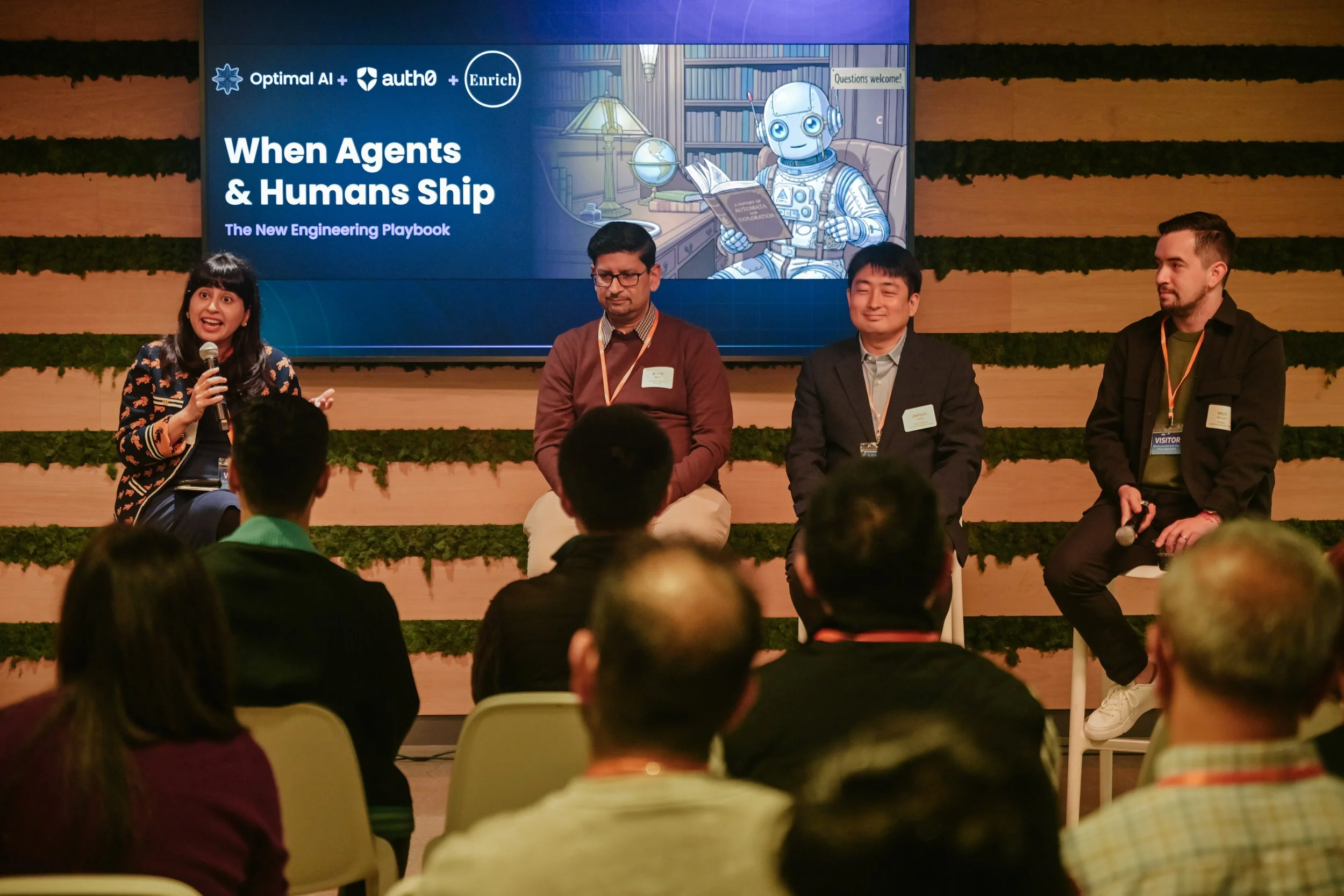
Enrich partnered with Optimal AI and Auth0 / Okta to bring engineering leaders together in San Francisco for a panel discussion on how AI agents are transforming software development.
The conversation featured:
Kinnar Vora, VP of AI, Forward Financing
Jaehyun Yeom, Principal Software Engineer, Bear Robotics
Mitch Mikusek II, Software Engineering Manager, Verkada
Moderated by Iba Masood, Co-founder & CEO of Optimal AI, the panel explored how their teams are deploying AI agents, navigating organizational change, and balancing faster development with engineering quality.
What emerged was a practical look at the opportunities and challenges of building AI-powered engineering organizations.
The hardest part of AI adoption isn't always the technology.
At Forward Financing, Kinar helped launch an AI innovation lab with three engineers and direct access to the CEO. The team had room to experiment, test ideas, and demonstrate what AI could accomplish before expanding those efforts across the organization.
But getting employees comfortable with experimentation required more than providing new tools.
Forward introduced internal learning groups, hackathons, and cross-functional initiatives to help employees understand AI's capabilities. Engineers were encouraged to experiment within established security guardrails without worrying that every unsuccessful attempt would be held against them.
Kinar emphasized the importance of creating a culture where the response to an unsuccessful experiment is "What did you learn?" rather than "Why did you do this?"
The larger challenge is moving beyond individual AI experiments to transforming how the business actually operates.
Kinar described this stage as the "messy middle": organizations recognize AI's potential, but integrating it into established workflows, processes, and teams is much harder than building a prototype.
Trust in AI agents is earned, not granted.
At Bear Robotics, where software interacts with robots operating in the physical world, engineering quality is particularly important.
Jaehyung shared how the company gradually introduced AI-powered code review rather than immediately handing over responsibility to autonomous agents.
The rollout began with a small group of engineers. Early reviews weren't perfect, often because the agents lacked context about the company's codebase and engineering conventions.
Instead of abandoning the approach, the team used that feedback to improve documentation, add context, and refine the review process.
As confidence grew, AI became the first stage of code review, with human engineers reviewing changes afterward.
Eventually, the team began allowing agents to autonomously approve and merge changes in carefully selected, low-risk areas where problems could be detected and reversed easily.
The key wasn't eliminating human oversight overnight. It was expanding autonomy as the team developed evidence that the system could be trusted.
Faster code generation makes engineering fundamentals more important.
One of the most interesting points from Jaehyung was that AI hasn't made traditional software engineering practices obsolete.
If anything, it's made them more valuable.
Clean code, clear documentation, automated testing, and manageable complexity all help AI agents generate and review code more effectively.
At Bear Robotics, feedback from AI code reviews revealed gaps in documentation and testing that the team could systematically improve.
That created a continuous improvement cycle: agents reviewed code, engineers identified recurring issues, and the team strengthened the underlying systems to prevent those problems from happening again.
As the volume of AI-generated code increases, engineering teams need stronger quality systems—not fewer of them.
Not everything needs to be an AI agent.
As organizations race to adopt agentic AI, Kinar offered a useful reminder: sometimes a simple script is the better solution.
Agents can introduce additional costs, complexity, and unpredictable behavior. For tasks that follow clear, repeatable rules, traditional automation may be more reliable.
His team has adopted a principle of evaluating whether a problem actually requires an agent before building one.
The distinction matters because the goal isn't to deploy as many agents as possible. It's to improve business outcomes.
That requires understanding the underlying problem, choosing the appropriate technology, and redesigning workflows where necessary.
Bringing engineers closer to the business accelerates innovation.
At Verkada, Mitch leads a small engineering team embedded within the company's growth and marketing organization.
Unlike traditional product engineering teams, his group works directly with stakeholders across sales, recruiting, demand generation, and marketing.
That proximity creates opportunities to move quickly.
Rather than working through lengthy requirements processes, engineers can sit down with stakeholders, understand their challenges, and iterate on solutions together—sometimes within a day or a week.
Mitch described how his four-person team divides its efforts between developing internal AI capabilities and supporting business teams directly.
The discussion highlighted an increasingly important shift: Engineering productivity isn't just about writing code faster. It's about reducing the distance between identifying a business problem and delivering a useful solution.
Human judgment still matters most at the beginning.
When asked where AI stops being productive, Mitch pointed to one area where his team still relies heavily on people: defining what to build.
AI can generate implementation ideas, but it doesn't always understand the nuances of a company's systems, stakeholders, or business priorities.
His team continues to use collaborative design sessions to work through architecture, requirements, risks, and testing strategies before handing implementation work to agents.
In-person whiteboarding and conversations also uncover information that might never appear in a formal specification.
Kinar reinforced this point during the audience Q&A, noting that AI makes it easier to experiment with potential solutions, but choosing the right problem requires broader business and technical judgment.
As agents take on more execution, the ability to understand problems, evaluate tradeoffs, and align stakeholders becomes even more important.
The next opportunity is bringing AI beyond engineering.
During the audience Q&A, Mitch shared that one of his biggest surprises has been discovering how many opportunities for AI adoption still exist across other business functions.
Teams in recruiting, sales, and marketing may not realize what's already possible with relatively simple AI tools and workflows.
Even within engineering, practices for evaluating agent performance, monitoring outputs, and validating AI-generated results are still evolving.
For example, an AI system might confidently generate a report using an incorrect SQL query. Without proper evaluation and testing, a polished output can conceal inaccurate results.
Kinar also challenged the audience to become more comfortable with genuine experimentation. Teams sometimes design experiments to succeed rather than risk learning something unexpected.
Real progress requires being willing to test assumptions, discover limitations, and improve based on what doesn't work.
The bottom line: The new engineering playbook is about more than speed.
AI agents are changing how software gets written, reviewed, and shipped. But the panel made clear that adopting agents successfully requires much more than introducing new development tools.
It requires stronger engineering foundations, thoughtful guardrails, a willingness to experiment, and closer collaboration between technical teams and the business.
Perhaps the biggest shift is in where human expertise creates the most value.
As agents take on more of the execution, engineering leaders have an opportunity to focus more on defining the right problems, designing reliable systems, and making the decisions that technology alone can't make.
———
At Enrich, we bring experienced technology leaders together to exchange practical lessons from the systems they're building, challenge assumptions, and learn from one another's experiences.
Want to join conversations like these with leaders navigating the same challenges? Apply to join Enrich.
