Building AI features has never been easier. But getting people to actually use them? That's becoming one of the biggest challenges facing product and technology leaders.
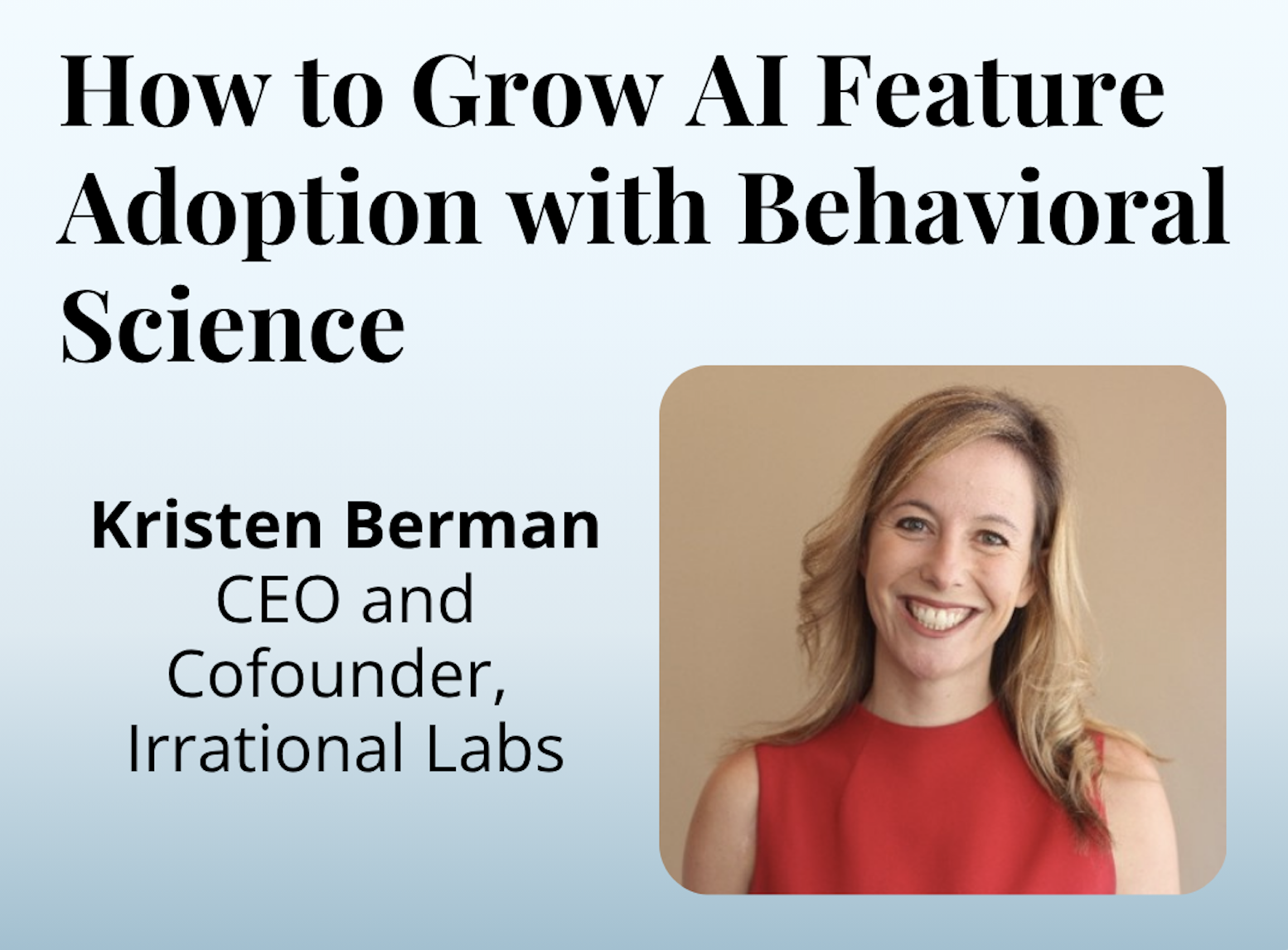
At a recent event, Enrich welcomed back Kristen Berman, CEO and co-founder of Irrational Labs, for her fourth session with our community.
Kristen, who helped establish Google's behavioral economics group, has worked with companies including Microsoft, Airtable, and Headspace to understand what drives human behavior and how to design products that encourage meaningful action.
Drawing on behavioral science research, real-world experiments, and lessons from more than 28 AI-focused engagements at Irrational Labs, Kristen explored a growing challenge: As companies accelerate AI development, how can they get customers to discover, trust, and consistently use the features they're building?
Here are the key takeaways from the discussion.
If you build it, they won't necessarily come.
Kristen opened with a surprising statistic: When Microsoft asked customers which features they wished existed, approximately 90% of their requests were for features already available in its products.
The problem isn't always that companies aren't building useful features. It's that customers don't know they exist, don't understand their value, or don't see a compelling reason to change their habits.
As AI accelerates product development, this gap is becoming even more pronounced. Companies can now build features faster than customers can discover and adopt them.
For product leaders, adoption needs to be part of the product strategy from day one, not an afterthought once a feature launches.
Your biggest competitor is the status quo.
People naturally gravitate toward familiar behaviors, even when better alternatives are available.
Kristen explained that one of the strongest predictors of whether someone will do something today is whether they did it yesterday.
That means every new AI feature is competing with an established habit.
Small amounts of friction can make an enormous difference. In one experiment Kristen shared, moving snacks just 11 feet farther from a coffee station reduced the likelihood of someone taking one from 21% to 12%.
The same principle applies to software. Extra clicks, unfamiliar interfaces, and unnecessary setup steps can be enough to discourage users from trying something new.
The easier a feature fits into an existing workflow, the more likely customers are to give it a chance.
Trust matters as much as functionality.
Even when customers understand what an AI feature does, uncertainty can prevent them from using it.
Will the output be accurate? Will it reflect their intentions? What happens if the AI makes a mistake?
Kristen explained how people's preference for certainty influences their willingness to try unfamiliar technology.
One important principle is giving users a sense of control. When people understand what an AI system will do and feel confident they can correct or reverse an outcome, they're more willing to experiment.
Building trust isn't just about improving AI performance. It's about designing experiences that make users feel comfortable taking the first step.
Don't make users guess what your AI can do.
Many AI products promise endless possibilities, but that flexibility can actually make adoption harder.
An empty chatbot interface might seem powerful to its creators, yet leave customers wondering what to ask or where to begin.
Kristen highlighted how products that clearly communicate specific capabilities can help users build confidence and discover value more quickly.
The goal isn't necessarily to limit what AI can do. It's to help customers understand what's possible without expecting them to become experts in the technology.
A powerful feature isn't particularly useful if customers can't figure out how to use it.
Getting users to try a feature is only half the battle.
Initial adoption doesn't guarantee long-term engagement.
Kristen explored how habits form and why even satisfied users may forget to return to a product.
One of the most important factors is connecting a feature to the moments when users actually need it.
Rather than relying on constant reminders or expecting customers to develop entirely new routines, product teams can design experiences that naturally become part of existing workflows.
The strongest retention strategies make returning feel useful and intuitive, rather than like another task users have to remember.
The big question: Are you building features, or building behaviors?
AI is making it easier than ever to turn ideas into working products. But the companies that succeed won't necessarily be those that ship the most features. They'll be the ones that understand how to get customers to use them.
Kristen's session was a reminder that great product development requires more than technical innovation. It requires understanding human behavior: what motivates people, what holds them back, and what makes them return.
For product and technology leaders, that raises an important question:
How can you make your product easier to discover, more intuitive to use, and valuable enough that customers keep coming back?
–––
At Enrich, we bring experienced technology leaders together to explore challenges like these, exchange practical lessons, and learn from experts and peers navigating the same questions.
Want to join conversations like these with leaders shaping the future of technology? Apply to join Enrich.
