The Future of Work for Developers in the Age of AI
In a recent Enrich-hosted webinar, Scott Breitenother, Co-founder & CEO of Kilo Code, shared sharp insights into the future of work for developers.
A year ago, the team at Kilo Code, an agentic engineering platform, was shipping one feature every two to three weeks. That was already considered fast. Today, that same team ships one to two features per week.
They have the same headcount and the same deadlines, but have made fundamental changes in how they operate.
The shift, as Kilo Code's CEO and co-founder Scott Breitenother describes it, is simple to state and hard to execute: start running your team like the tools you have today are the floor, not the ceiling. In a recent conversation with Enrich members, Scott unpacked what that transformation looks like in practice.
The Peanut Butter Problem
When companies report that AI isn't making them faster, Breitenother says the diagnosis is almost always the same. They took an organization and spread AI on top of it.
"They're like, we got AI, we gotta move fast now," he said. "The reality is, you really do have to revamp and rethink the entire software development cycle."
The gains Kilo Code has seen come from two pillars. The first is culture and process, which is how teams work, ship, and validate. The second is having a platform that works with you rather than against you. Most companies rush to find the second and never seriously address the first.
Stop Collaborating (Sort Of)
The most provocative claim from the webinar was that Kilo Code is "very anti-collaboration." Not because they dislike it, but because human-to-human interfaces are now the slowest link in the chain.
"Code is cheaper," Breitenother explained. "The bottleneck right now is people coordinating with other people." In response, the team has systematically dismantled every process that existed as a comfort mechanism rather than a genuine value-add. Things like the PRD that waits two weeks for five stakeholders, the PR review stuck in a queue, and the recurring check-in that exists just because it has always been on the calendar.
What replaced it is a model Scott calls single-threaded ownership. They have one developer per feature who owns the work from conception through architecture, implementation, deployment, and user feedback. This bypasses slow handoffs and waiting.
The New Team Structure
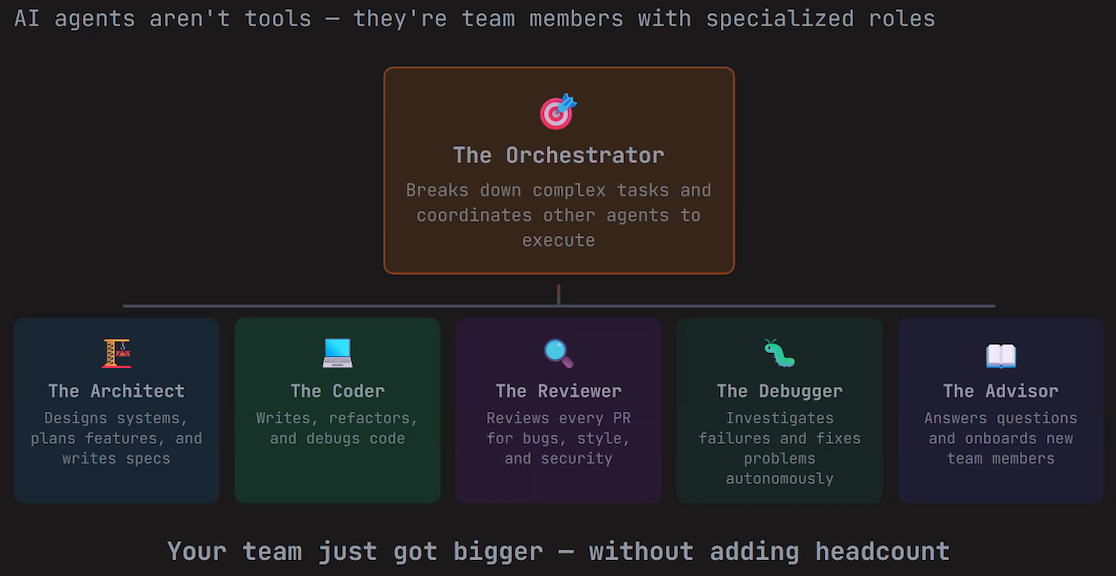
Forget the two-pizza team. Kilo operates on what Breitenother calls the two-slice team. Instead of a group of five developers, you have one human with deep domain expertise managing a team of specialized AI agents. The human is orchestrating the Architect > Coder > Reviewer > Debugger > Advisor. Together, they do the work that previously took four or five people, and they avoid the coordination tax.
What This Looks Like For the Developer
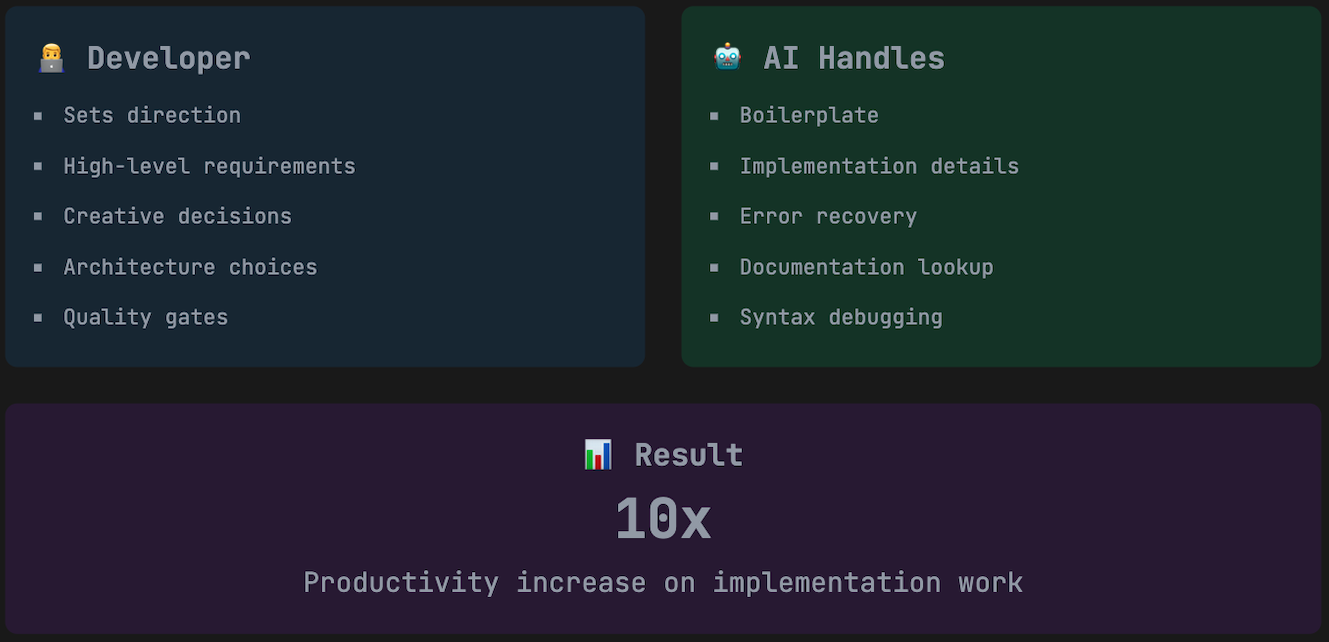
The developer's job description flips entirely. Where engineers once spent roughly 20% of their time on high-level thinking and 80% writing code, that ratio inverts. "Now you're doing 80% big brain work and 20% coding," Breitenother said. "It definitely is more mentally taxing."
His analogy is that the developer becomes the conductor of the orchestra, not the first-chair violinist. Leadership needs to be aware that not everyone makes that transition easily. "We hire extremely well at Kilo," he noted. "People pass every single test. But some of them cannot make the leap from first chair violinist to conductor."
For junior developers, the picture is more optimistic. They're immediately confronted with strategic, architectural questions and skills that traditionally took years to develop. By pairing them immediately with AI, or as Breitenother put it, "the most experienced developer in the world," the newbies are seeing best practices enforced from day one.
Ship Fast, Ship Safely, Learn Fast
Speed doesn't mean recklessness. Kilo Code's shipping philosophy rests on three legs. First, pick the MVP and get it in front of users quickly. Code that is just sitting in GitHub generates ZERO value, ZERO feedback, and it cannot be optimized. Second, every single line of code gets reviewed by an AI agent before a human decides how deeply to engage. Third, because they ship fast, they learn fast: user feedback arrives sooner, gets actioned in hours or days, and compounds into a better product for users in a shorter timeline.
"It's speed, but it's not move fast and break things," Breitenother was careful to note. "AI is the guardrail. It's the safety net."
Challenges with Large Organizations
An Enrich member raised the challenge most large organizations face. They don’t have greenfield development, but existing codebases with years of accumulated complexity, implicit knowledge, and human relationships baked into the architecture. It's a fair challenge, and Breitenother acknowledged Kilo Code's small, low-debt codebase makes some of this easier to preach than practice.
His honest answer was that the "grizzled veteran who knows how everything connects" is being gradually replaced by AI. While we're still a couple years away from that, what's available now is AI as a capable detective, surfacing dependencies and flagging risks. It's not perfect, but it's getting better fast.
A concrete first step for organizations looking to modernize legacy systems is to retro-document the codebase. Allowing AI agents to review, learn, and document the codebase in detail is a great first step.
The Proof Is In Production
Kilo Code shipped Cloud Agents, Code Reviews, App Builder, managed indexing, and Agent Manager in six weeks, which is one major feature per week. The company's current ~20-person engineering team isn't projected to reach 50 or 60 engineers. Breitenother expects to be at 23, maybe, a year from now.
"The future of work is already here," he said. Teams should be built with that mindset.
Key Principles
One developer owns a feature end-to-end
No recurring review meetings by default
AI reviews every line before a human does
Ship the MVP; iterate in hours
Document PRs with full origin stories
What’s Dying
Developer as code monkey
Collaboration as default mode
PR reviews waiting days for humans
PRDs open for two weeks
5 humans: 1 agent
What’s Emerging
Developer as orchestrator
Single-threaded ownership
80% strategic thinking, 20% coding
Full stack, dependency-free engineers
1 human: 5 agents
