As AI makes building products faster and easier, what will actually set great products—and the leaders behind them—apart?
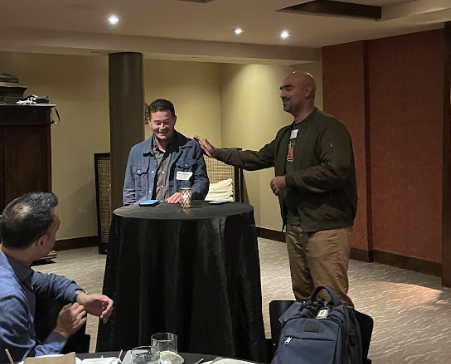
At a recent Enrich dinner in San Francisco, we explored that question with Ross Schwaber, whose career spans major technology shifts at OpenTable, Bleacher Report, Outdoorsy, and now THOR Industries.
Moderated by Shujaat Ahmad, the conversation covered everything from installing servers in restaurants before the cloud existed to building personalized media experiences, scaling marketplaces, and rethinking products in the age of AI.
Across these very different businesses, one theme kept emerging: Technology changes, but understanding customers and building something they genuinely value never goes out of style.
Here are some of the most interesting lessons from the evening.
Your customers know things your data doesn't.
When OpenTable expanded into Germany, the team couldn't understand why restaurants in certain regions weren't adopting its software.
The answer wasn't in the analytics. It was in the restaurants themselves.
In Bavaria, many establishments followed a tradition called Stammtisch, where groups held recurring reservations indefinitely. OpenTable didn't support that workflow, making the product a poor fit for how those restaurants actually operated.
It was a lesson Ross carried throughout his career: You can't build great products without understanding how your customers live and work.
Sometimes the most valuable product research happens when you leave your desk and watch someone use your product in the real world.
Data tells you what's happening. Judgment tells you what to do about it.
At Bleacher Report, Ross helped pioneer a more personalized approach to sports content.
The team recognized that knowing someone was a 49ers fan could immediately make their experience more relevant. But personalization also revealed something bigger: people didn't care whether the content came from Bleacher Report. They cared whether it was worth reading.
Rather than limiting users to its own content, Bleacher Report embraced aggregation, surfacing relevant stories from across the internet.
The lesson wasn't simply about personalization. It was about solving for what customers value rather than optimizing what your company wants them to consume.
Analytics can reveal patterns, but deciding what to build still requires curiosity, context, and product judgment.
The best marketplaces help their sellers become more successful.
At Outdoorsy, Ross learned that marketplace growth isn't just about attracting more buyers and sellers. It's about identifying the participants who create the most value and helping them thrive.
Some RV rental operators were still managing reservations with clipboards and paper calendars. Outdoorsy introduced software to streamline their operations, then expanded into financing and insurance to address other barriers to growth.
Insurance ultimately became a particularly valuable part of the business.
What started as an RV rental marketplace evolved into something much broader because the team kept asking: What else is preventing our customers from succeeding?
For marketplace leaders, the opportunity often extends well beyond the original transaction.
Great technology means little without a business case.
Convincing restaurants to adopt OpenTable wasn't easy. The company was asking businesses to replace familiar processes with unfamiliar technology.
Rather than selling software features, the team focused on outcomes restaurants cared about: filling empty tables, reducing staffing demands, and generating incremental revenue.
Ross also highlighted the importance of understanding customer acquisition economics. OpenTable could justify its investment through long-term restaurant relationships, while Outdoorsy's higher-value transactions supported a different acquisition model.
The underlying principle applies just as much today: Customers don't buy technology because it's impressive. They buy it because it solves a problem worth paying for.
AI should make the experience better—not become the entire experience.
Ross offered a simple way to distinguish an AI-native product from one with AI features: If you removed the AI, would the product still exist?
But he also questioned whether every experience needs to become entirely AI-driven.
In his current work in the RV industry, for example, AI can help first-time owners understand unfamiliar equipment, troubleshoot problems, and feel more confident using their vehicles.
The goal isn't to replace the experience of traveling or camping. It's to remove the friction that gets in the way.
It's an important distinction as companies race to introduce AI into their products: The opportunity isn't always to reinvent the experience. Sometimes it's to make an already valuable experience dramatically better.
AI is making execution cheaper. That makes good judgment more valuable.
Ross compared today's AI revolution to the arrival of cloud computing.
Before the cloud, building a new product could mean purchasing expensive servers and waiting for infrastructure teams to install them. Cloud computing removed much of that friction.
AI is creating a similar shift in how quickly teams can turn ideas into working products.
It's even changed Ross's personal workflow. Rather than doing all his thinking through writing, he increasingly approaches work as an editor: providing context, letting AI produce an initial version, and using his judgment to refine it.
But faster execution doesn't guarantee better results.
When almost anyone can build something, knowing what to build, why it matters, and whether it's actually good becomes the real differentiator.
The next big opportunities may be in unexpected places.
Looking ahead, Ross pointed to several advantages he believes will remain valuable in an AI-driven world: proprietary datasets, strong network effects, and businesses connected to physical infrastructure.
He also sees opportunity in established industries that have been slower to adopt modern technology.
These businesses may not attract the same attention as the latest AI startups, but many have significant operational challenges that technology could help solve.
For technology leaders thinking about what's next, the most interesting opportunity might not be another software company. It could be bringing modern capabilities to an industry that's been underserved for decades.
The bottom line: Don't chase the technology. Chase the problem.
From OpenTable's early restaurant installations to AI-powered experiences today, Ross has seen firsthand how dramatically technology can change the way products are built.
But the principles behind successful products remain surprisingly consistent.
Get close to your customers. Understand the economics. Solve meaningful problems. And use new technology where it creates genuine value.
As AI lowers the barriers to building, the leaders who stand out won't necessarily be those who move the fastest. They'll be the ones who know where to focus.
At Enrich, conversations like these bring experienced technology leaders together to share lessons from the work they've done, challenge assumptions, and learn from one another's perspectives.
Want a seat at the next conversation—and the opportunity to bring your own questions to the room? Apply to join Enrich.
